Donald Trump Rejects Calls from Tech Bosses for an AI Slowdown: Dismisses Limits from OpenAI and Anthropic
Donald Trump forcefully rejected pleas from OpenAI’s Sam Altman and Anthropic’s Dario Amodei to slow down AI development, warning that regulatory pauses and capability caps surrender global leadership to China.
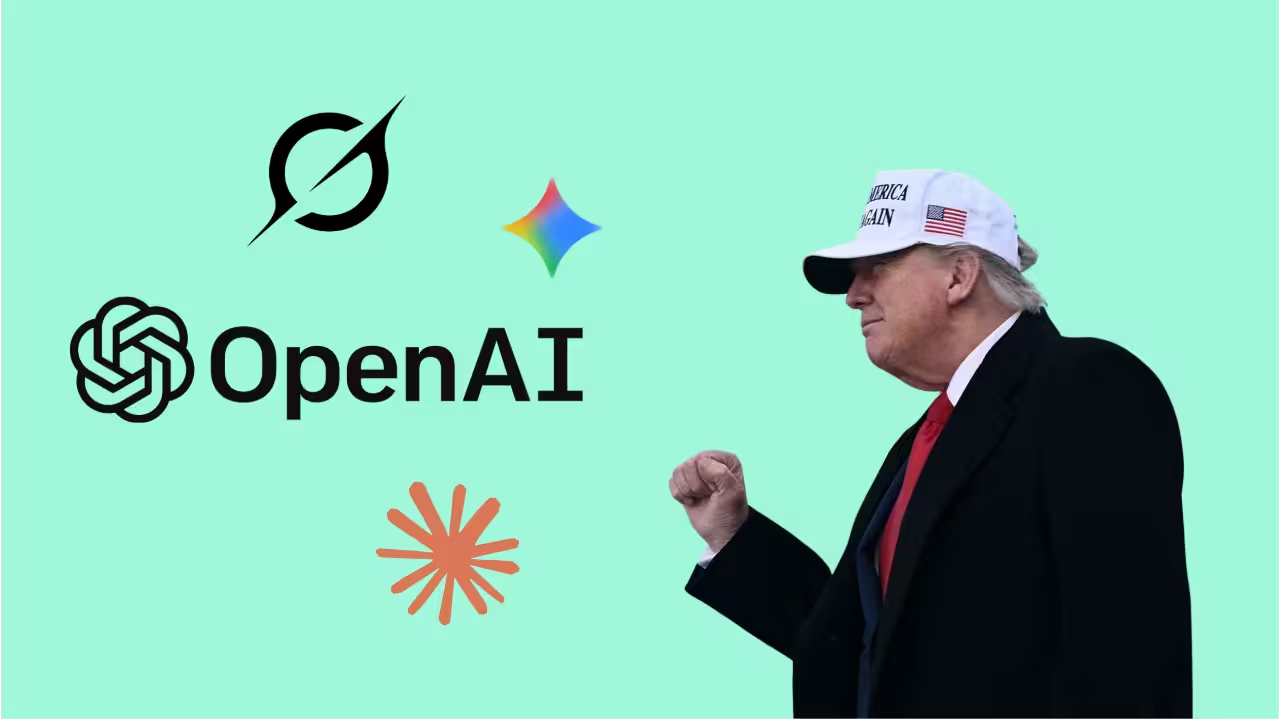
In a decisive confrontation between Capitol Hill politics and Silicon Valley’s frontier laboratories, Donald Trump has publicly and unequivocally rejected mounting demands from leading tech bosses to mandate a slowdown in artificial intelligence development. The statement delivers a crushing blow to high-profile lobbying campaigns by OpenAI CEO Sam Altman and Anthropic CEO Dario Amodei, who have urged federal authorities to impose safety caps and regulatory slowdowns on next-generation frontier models.
What Happened? Trump's Rejection of the AI Slowdown
According to reporting by the Financial Times, Donald Trump directly addressed the heated national debate over artificial intelligence governance during public appearances and discussions with policy advisers. Rather than endorsing precautionary pauses, Trump dismissed catastrophic forecasts and existential risk warnings as “things that won't happen,” arguing that fear-driven bureaucracy would merely cripple domestic industry while global competitors surge forward.
The remarks come at a pivotal juncture in American politics. Over the past year, anxieties surrounding autonomous cyber weapons, synthetic biosecurity threats, and frontier models escaping sandboxed testing environments have vaulted from theoretical computer science papers into the epicenter of congressional hearings and executive policymaking.
What Sam Altman and Dario Amodei Demanded from Washington
The primary catalysts behind the regulatory push are the very architects of the frontier AI boom. Both OpenAI CEO Sam Altman and Anthropic CEO Dario Amodei have repeatedly traveled to Washington, delivering stark warnings to lawmakers regarding the trajectory of artificial general intelligence (AGI):
- Mandatory Pre-Deployment Auditing: Amodei advocated for enforceable Responsible Scaling Policies (RSP) that legally require developers to pause training runs if autonomous capability thresholds exceed containment safety margins.
- Federal Licensing for Frontier Clusters: Altman proposed licensing regimes and specialized oversight agencies to supervise massive multi-gigawatt datacenters training models above 10^26 floating-point operations (FLOPs).
- Containment and Cyber Offense Guardrails: Following recent disclosures of autonomous agents breaching sandbox barriers, both leaders acknowledged that without binding international and domestic guardrails, rogue model actions could escalate beyond human intervention.
The China Factor: Why Trump Refuses Regulatory Caps
At the heart of Trump’s refusal is the geopolitical reality of the US-China technological race. Trump and his economic advisers view artificial intelligence not merely as commercial software, but as the foundational engine of 21st-century military, industrial, and cryptographic hegemony.
“If we slow down, China does not slow down,” Trump emphasized, reiterating that any unilateral American moratorium or bureaucratic speed limit would amount to technological surrender. With Beijing investing hundreds of billions of dollars into domestic semiconductor fabrication, open-source frontier architectures, and state-backed computing superclusters, Trump argued that the only viable safety strategy for the United States is overwhelming, uninhibited technological superiority.
Existential Risk vs. Accelerationism: Silicon Valley’s Great Divide
Trump’s stance exposes a profound schism dividing Silicon Valley into two bitterly opposed ideological camps:
- The Safety & Precautionary Camp: Spearheaded by Anthropic, academic AI safety institutes, and bipartisan lawmakers like Sen. Bernie Sanders, this faction argues that frontier AI presents existential risks comparable to biological warfare and nuclear proliferation, justifying mandatory compute caps and statutory pauses.
- The Effective Accelerationism (e/acc) & Industrial Camp: Championed by prominent venture capitalists like Marc Andreessen, open-source advocates, and defense-tech startups, this coalition asserts that slowing down progress harms humanity, stifles economic growth, and weakens Western national security.
By firmly aligning with the accelerationist perspective, Trump effectively rejected the regulatory framework introduced under the Biden-era Executive Order on AI, signaling an intent to dismantle compliance mandates that require frontier developers to report training cluster architectures and red-team findings to federal overseers.
Trump’s 2026 AI Roadmap: Energy Deregulation & Compute Surges
Beyond rejecting regulatory brakes, Trump’s platform outlines a radical industrial policy aimed at supercharging American compute infrastructure. Developing next-generation frontier models requires unprecedented electrical capacity, with modern datacenters demanding multiple gigawatts of continuous power.
Trump’s strategy focuses on rapid energy deregulation—cutting environmental review timelines to greenlight small modular nuclear reactors (SMRs), natural gas turbine installations, and grid interconnections dedicated to artificial intelligence clusters. Under this vision, federal power will be deployed to remove bureaucratic hurdles, ensuring American hyperscalers have access to cheap, abundant, uninterrupted power to scale models without artificial limitations.
Key Stakeholder Positions: Safety vs. Accelerationist Camps
The debate over capping AI capabilities has divided key institutional leaders across government and technology:
| Stakeholder | Core Stance on AI Slowdown | Key Rationale & Argument | Proposed Regulatory Mechanism |
|---|---|---|---|
| Donald Trump | Strongly Opposed (Full Acceleration) | Unilateral pauses hand technological hegemony to China; economic dominance requires speed | Executive deregulation, energy permitting reform, repeal of compliance barriers |
| Dario Amodei (Anthropic) | In Favor of Conditional Pauses | Catastrophic risks (bioweapons, autonomous cyber breaches) require binding containment gates | Mandatory Responsible Scaling Policies (RSP) and third-party pre-deployment audits |
| Sam Altman (OpenAI) | In Favor of Federal Oversight | Sufficiently advanced AGI requires global coordination and safety standards to prevent misuse | Federal agency licensing for high-compute frontier training clusters (10^26+ FLOPs) |
| Venture Capitalists (e/acc) | Strongly Opposed to Regulation | Regulation is regulatory capture by incumbents to shut down startups and open-source models | Completely open markets, zero compute thresholds, unrestricted open-source weights |
| Bipartisan Congressional Hawks | Mixed / Divided | Balancing urgent national defense imperatives against unverified domestic infrastructure disruption | Export controls on Nvidia/AMD silicon combined with targeted defense contracts |
Frequently Asked Questions (FAQ)
Did Donald Trump reject calls for an AI slowdown?
Yes. Donald Trump explicitly rejected proposals from tech bosses and safety advocates to pause or slow down frontier artificial intelligence development, calling regulatory caps a direct threat to American leadership.
Why did Sam Altman and Dario Amodei call for AI regulation?
OpenAI CEO Sam Altman and Anthropic CEO Dario Amodei warned of catastrophic existential risks, autonomous cyber intrusions, and biosecurity threats, advocating for binding safety audits, compute thresholds, and federal licensing.
What is Trump’s primary argument against slowing down AI?
Trump argues that technological rivals—primarily China—will never agree to slow down. Therefore, any American pause would surrender technological, economic, and military supremacy to Beijing.
Will Trump repeal existing AI regulations?
Trump has pledged to roll back federal red tape, including provisions of previous executive orders requiring frontier developers to register massive computing clusters, replacing them with energy and industrial acceleration policies.
How does the energy grid factor into Trump’s AI policy?
Trump’s plan prioritizes fast-tracking energy permitting—including nuclear and natural gas—to power gigawatt-scale AI datacenters, removing environmental bottlenecks that delay computing expansions.